
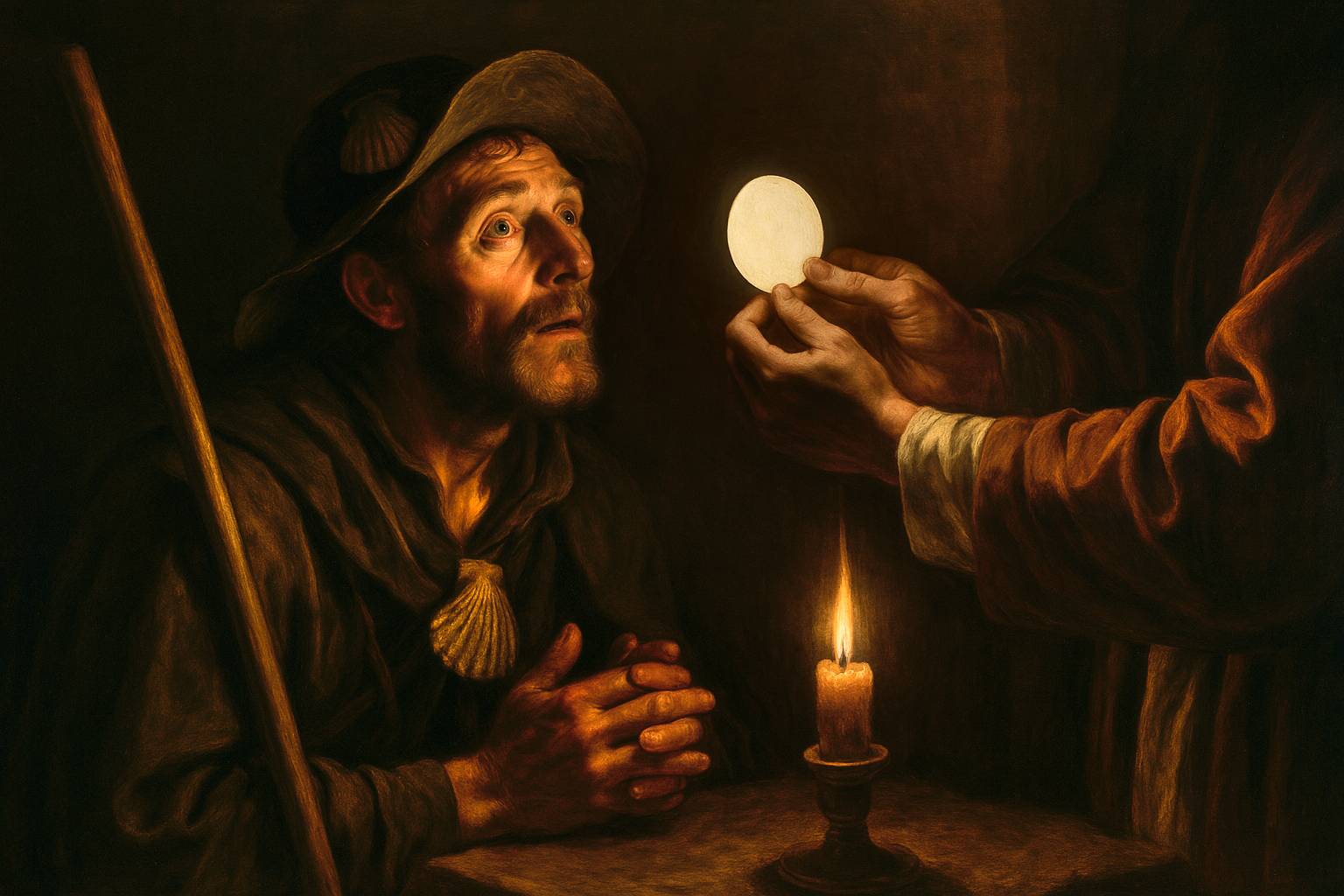
The Eucharistic Mystery Across Time and Space
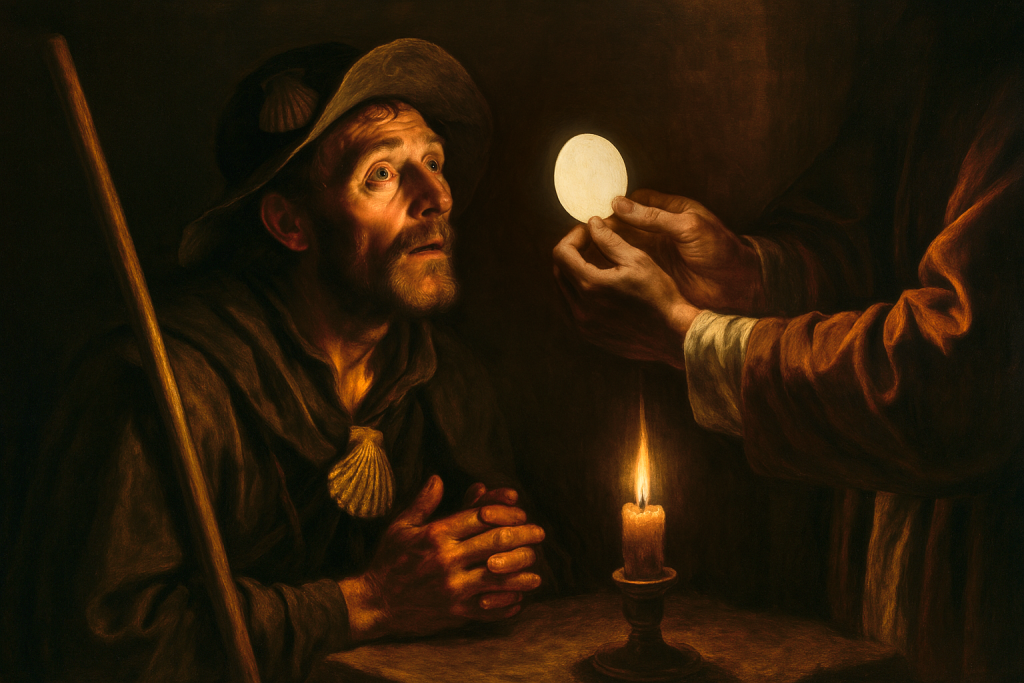
One stormy night in 14th-century Galicia, a priest in the small mountain village of O Cebreiro was celebrating Mass. His heart had grown cold; he no longer believed in the Real Presence of Christ in the Eucharist. Yet one lone pilgrim still arrived — exhausted, soaked by the snowstorm, but determined to attend the Holy Sacrifice.
As the priest spoke the words of consecration, the host visibly transformed into flesh, and the wine became blood, spilling onto the corporal. It was a miracle — not a punishment for doubt, but a divine act of mercy.
This miracle at O Cebreiro was not an isolated event. Similar Eucharistic miracles have occurred in France, Italy, Poland, Argentina — across centuries and cultures. God repeatedly reminds us: “I am truly here.”
Not Just a Story — A Theological Wake-Up Call
Some critics mock Catholic teaching on the Eucharist, accusing it of being “unbiblical” or even pagan. One such critic cited Hebrews 9:12 to deny the Catholic understanding: “He entered once for all into the Holy Place… by means of His own blood.” The irony? This verse confirms the Catholic belief.
The sacrifice of Christ is indeed “once for all” — but it is not past. Hebrews 9:24 continues: “Christ has entered into heaven itself, now to appear in the presence of God on our behalf.” His priesthood is eternal (Hebrews 7:24), and He lives to make intercession for us (7:25). He is still the active High Priest.
So how is that one eternal sacrifice made present to us today? Through the Eucharist.
The Early Church Believed in the Sacrifice of the Mass
In the second century, St. Justin Martyr described the Eucharist not as a symbolic meal, but as a true sacrificial offering. It was “not common bread and common drink,” but the Body and Blood of Christ. He called it the Sacrifice, not a mere service or memorial.
That’s why early Christians worshiped with awe: kneeling, silence, incense, Latin, chant — not to impress, but to reflect what they believed. Lex orandi, lex credendi: the way we worship shows what we believe.
If Christ is truly present on the altar, then nothing about the liturgy should feel casual.
The Eucharist Is Not Cannibalism — It Is Mystery
Critics often claim Catholics believe they are physically drinking blood — something both Old and New Testament forbid. But this objection misunderstands what the Church teaches. We do not consume Christ’s physical tissue or literal blood cells.
The Church teaches the Real Presence — Christ’s glorified, risen Body and Blood, made sacramentally present under the appearances of bread and wine. It is not cannibalism. It is a mystical, sacramental reality, just as Christ passed through locked doors after His resurrection.
Only in rare Eucharistic miracles do the appearances change — for instance, to visible heart tissue (as in Lanciano) or blood (as in Buenos Aires). Even then, the Church treats these signs with reverence, not as everyday occurrences.
Melchizedek and the New Sacrifice of Bread and Wine
Hebrews 7:17 calls Christ a priest “after the order of Melchizedek” — a mysterious figure from Genesis 14:18 who offers bread and wine, not animal sacrifice. This priesthood is not tribal (like Levi’s), but eternal and kingly.
At the Last Supper, Christ — the true Melchizedek — offers bread and wine as His Body and Blood. This is no ordinary meal. The Passover itself, as described in Exodus 12, is called a sacrifice. Jesus, the Lamb of God, unites the Last Supper and the Cross into a single Paschal offering.
And how does this offering continue?
The prophet Malachi foresaw it: “From the rising of the sun to its setting, a pure offering will be made in every place” (Mal 1:11). Not abolished — but transformed. No more animal blood, but the one perfect offering — Christ — re-presented at every Mass.
“Do This in Memory of Me” — What Jesus Really Meant
When Jesus said, “Do this in memory of me,” He was not calling for a symbolic ritual. In the biblical tradition, especially in the context of the Passover, “memory” (Greek: anamnesis) means making present — a real participation in the original event. At the Jewish Passover, the father says, “The Lord brought me out of Egypt” — not them, but me — centuries after the Exodus.
Likewise, the Eucharist is not just a commemoration, but a true sharing in Christ’s sacrifice. St. Paul affirms this in 1 Corinthians 10, where he draws parallels between pagan sacrifice, Jewish sacrifice, and the Christian Eucharist: those who eat the sacrificed food enter communion with the deity.
Paul asks: Are we not partaking of the Body and Blood of Christ through this meal? Yes — but this meal is also the sacrifice. He calls the chalice “the cup of blessing” — a direct liturgical reference.
Hebrews 13:10 is even more explicit: “We have an altar from which those who serve the tent have no right to eat.” An altar. Not a table. And altars are for sacrifice.
The early Church understood this well. The Eucharist is the sacrifice of the new covenant — not a new crucifixion, but the same once-for-all offering of Christ, made present for every generation.
The Biblical Language of Transubstantiation
Some claim the word “transubstantiation” is a medieval invention. But in the Greek of the Our Father, we find the term epiousion — commonly translated as “daily” bread, but literally meaning “super-substantial” (epi + ousia). This is the only time this word appears in all of Greek literature. It hints at the supernatural nature of the Eucharistic bread.
Even the early Church Fathers linked this to the Eucharist — the “bread above substance,” the Bread of Life.
The Institution of the Priesthood
When Jesus says, “Do this in memory of Me,” He gives the apostles the same priestly role He Himself exercised: to offer the new covenant sacrifice.
This is further confirmed in the foot-washing at the Last Supper. Jesus performs this act during the meal, not before — unlike typical hospitality customs (Gen 18:4, Luke 7:44). This unusual timing echoes Exodus 29–30, where priests are washed before offering sacrifice.
Jesus tells Peter: “Unless I wash you, you have no share with Me.” This is not just about salvation — but about sharing in Christ’s priestly mission. He washes only the Twelve, not the wider group of disciples. This act, right before the institution of the Eucharist, symbolizes their initiation into the priesthood of the New Covenant.
O Cebreiro Is Everywhere
The miracle of O Cebreiro is not confined to Galicia. It happens invisibly at every Mass.
Every altar is a new Calvary. Every tabernacle holds the same divine presence.
If you want to worship as the early Christians did — with awe, reverence, and full belief in the Eucharist — discover the Traditional Latin Mass.
Because if He is truly here… then nothing should feel casual.
Leave a Reply